Nate Postlethwait presents himself as a writer sharing his thought on trauma recovery.
Some of his thoughts:
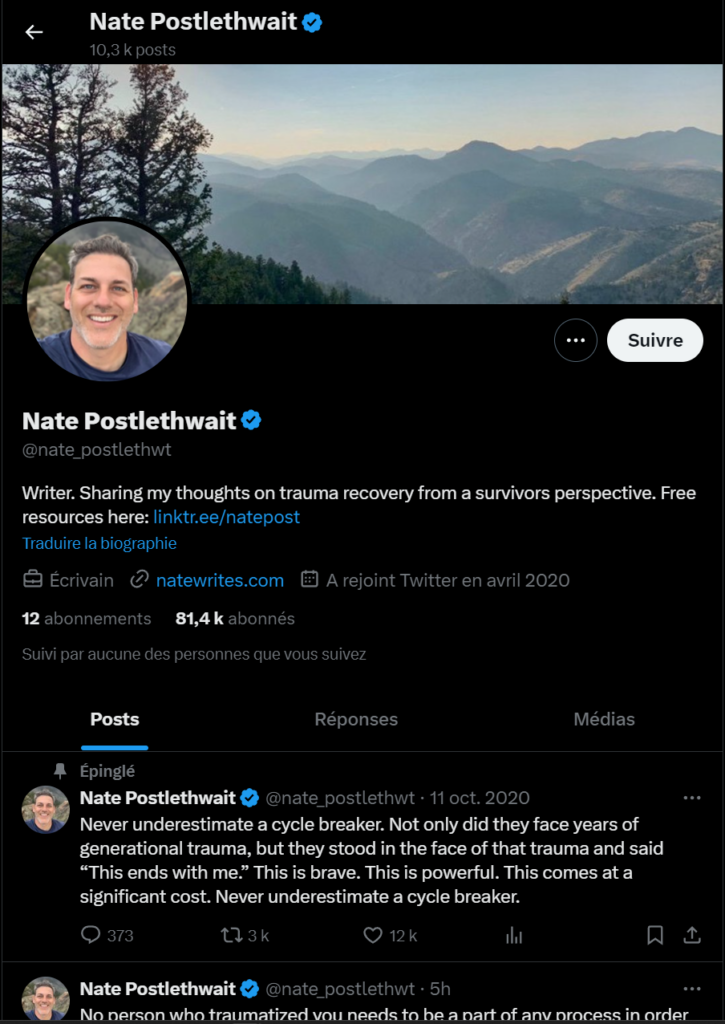
His X (Twitter): https://x.com/nate_postlethwt
His blog: https://natewrites.com/blog

Nate Postlethwait presents himself as a writer sharing his thought on trauma recovery.
Some of his thoughts:
His X (Twitter): https://x.com/nate_postlethwt
His blog: https://natewrites.com/blog
Help us improve this article
Add a clear point? Share it in comment.
Link or video not working? Post a new one that works in comment.
Fact wrong or out-of-date? Write the correct info in comment.
Your feedback helps keep the content accurate and valuable.
We often think of great leaders as great talkers. We imagine them giving rousing speeches, setting a clear vision, and having an answer for everything. But a massive review of scientific research suggests we have it backward. The most effective way to improve your leadership isn’t to speak more; it is to listen better.
New data shows that listening is not just a “soft skill” for making friends – it is a hard driver of job performance and professional success.
A recent meta-analysis published in the Journal of Business and Psychology examined the link between listening and work outcomes. The researchers looked at data from 144 studies involving more than 155,000 people.
Their conclusion was clear: listening has a strong, positive effect on employee job performance.
Leaders who are perceived as good listeners do more than just make their employees feel warm and fuzzy. They actually get better results. The study found that listening improves the quality of relationships at work, which in turn boosts performance. When employees feel heard, they perform better. This dynamic helps leaders unlearn bias and lower conflict within teams.
As the researchers noted, the link between listening and positive job outcomes is “robust.” They suggest that listening is an underrated predictor of job performance – a simple cause of superior results that many organizations overlook.
If listening is so effective, why is it so hard? Why do so many of us default to talking instead?
The answer lies in our biology. A study published in the Proceedings of the National Academy of Sciences (PNAS) found that talking about ourselves is inherently rewarding. In fact, humans devote about 30–40 percent of everyday speech to informing others about their own subjective experiences – their thoughts, feelings, and opinions.
Using brain scans, researchers found that self-disclosure activates the mesolimbic dopamine system – the same brain regions associated with the pleasure we get from food, money, and sex. It feels good to talk about yourself.
The drive is so strong that people in the study were willing to give up money just to keep talking about themselves. When given a choice between answering questions about others for a higher payment or answering questions about themselves for a lower payment, participants voluntarily gave up between 17 and 25 percent of their potential earnings to talk about their own views.
We are wired to broadcast. To lead effectively, you have to fight that wiring.
You can become a better listener instantly by changing how you ask questions. It is not enough to just stay silent; you need to show you are engaged.
Research published in the Journal of Personality and Social Psychology found that the specific type of question you ask matters. The study showed that asking follow-up questions – questions that ask for more detail on what the other person just said – dramatically increases how likable you appear.
When you ask a follow-up question, you prove you were listening. You signal validation, care, and understanding. This simple habit makes you more persuasive and influential because, as other research in Frontiers in Psychology shows, likable people are better at influencing those around them.
Asking follow-up questions and recalling small details are among seven habits that mark an exceptional listener, and this research confirms it is a key tool for leaders.
Listening does more than build rapport; it meets a fundamental human need.
A study in the Journal of Personality and Social Psychology found that employees feel less objectified when their boss knows them as people, rather than just as workers or numbers. Furthermore, research linked to the Journal of Experimental Psychology suggests that “feeling known” is a necessary precursor to “feeling supported.”
You cannot support an employee you do not know. You cannot help them reach their career goals if you never asked what those goals were. You cannot solve their roadblocks if you never listened to what those roadblocks are.
To become a better leader today, flip the ratio of your conversations.
Mastering conversation: how active listening keeps dialogue engaging is a skill you can practice in every interaction, whether with a colleague, a client, or a friend.
A meta-analysis of 144 studies involving 155,000 observations found that perceived listening is strongly correlated with improved job performance and relationship quality.
Neuroimaging research shows that self-disclosure activates the brain’s reward systems, motivating people to talk about themselves even at a financial cost.
A series of studies demonstrates that asking follow-up questions increases interpersonal liking by signaling responsiveness and listening.
Perfection is often overrated. While we strive to be flawless in job interviews or first dates, psychology suggests that being too perfect can actually push people away. A small blunder, like tripping or spilling a drink, might do more for your popularity than a flawless performance. This phenomenon is known as the Pratfall Effect.
The Pratfall Effect is a psychological principle that states that a person’s likability increases when they make a clumsy mistake, but only if that person is already perceived as competent.
Social psychologist Elliot Aronson first identified this effect in 1966. He wanted to test how mistakes influence attraction. In his famous experiment, he asked male college students to listen to tape recordings of people answering quiz questions.
The participants heard one of two main scenarios:
Aronson then added a twist. In some recordings, the “Superior Person” commits a blunder at the end: they are heard spilling a cup of coffee and reacting to the mess.
The results were clear. The students rated the Superior Person who spilled the coffee as the most likable of all. The blunder made the highly competent person seem more human and approachable.
There is a crucial condition to this effect. A mistake only helps you if you have already established your competence.
In Aronson’s experiment, when the “Average Person” (who missed most quiz questions) spilled the coffee, their likability rating dropped even further.
This distinction is vital. You cannot simply be clumsy and expect to be popular. You must first demonstrate that you are good at what you do. The blunder acts as a softener for your competence, not a substitute for it.
We see the Pratfall Effect in action in celebrity culture and marketing.
Jennifer Lawrence is often cited as a modern example. Her frequent trips on the red carpet or candid, unpolished interviews often endear her to the public. Because she is an Oscar-winning, highly successful actress (high competence), these slips make her seem “down to earth” rather than clumsy.
Marketing experts use a similar concept known as the “blemishing effect.” When a brand admits a small flaw, consumers often trust it more. For example, Guinness: the beer brand famously turned a negative – the long time it takes to pour a pint – into a legendary slogan: “Good things come to those who wait.”
The Pratfall Effect challenges the idea that we must hide our flaws to be accepted. In social situations, perfection creates distance. We often struggle to connect with someone who seems to have no weaknesses because we cannot relate to them. This relates to understanding conversational biases to become more likable, where showing genuine engagement often matters more than saying the perfect thing.
When a competent person slips up, it levels the playing field. It signals vulnerability. This vulnerability fosters trust and signals that the person is authentic, not a curated persona.
You do not need to stage accidents or spill coffee on purpose. However, you can change how you react to your own errors.
The original study published in Psychonomic Science where Aronson and his colleagues demonstrated that a blunder increases the attractiveness of a superior person but decreases the attractiveness of a mediocre person.
An analysis of how brands like Guinness and VW use the Pratfall Effect to build trust by admitting minor weaknesses, making their core claims more believable.
Research showing that under certain processing conditions, a small amount of negative information can actually enhance the positive impression of a product.
Imagine never needing your glasses again. No surgery, no contacts, just… fixing your eyes yourself. That’s the big promise of Endmyopia, a popular online method created by Jake Steiner. He claims you can reverse nearsightedness (myopia) just by changing your habits.
It sounds awesome, right? But before you throw away your glasses, you need to know that most eye doctors and scientists say it’s not that simple. Here is the lowdown on what this method is, why people try it, and why the medical consensus says it probably won’t work like you think.
Endmyopia is based on a simple idea: your eyes aren’t broken; they are just reacting to your environment.
The theory goes like this: when you spend hours staring at your phone or laptop, a focusing muscle inside your eye gets tired and cramps up. This is called pseudo-myopia. At first, your vision is only blurry because of this cramp.
The controversial part is what happens next. Steiner says that when you wear glasses to fix that blur, your eye physically grows longer to “adapt” to the lenses. A longer eyeball is what causes true nearsightedness. Basically, the method claims your glasses trap you in a cycle that makes your vision worse.
To reverse this, Endmyopia tells you to do two things:
Here is the problem: Eye doctors agree that once your eyeball grows too long, it usually stays that way. It’s like your height – once you grow tall, you don’t shrink back down just because you want to.
You can train a muscle to get bigger, but you can’t really train an eyeball to get shorter. While atropine drops or special contact lenses can slow down eye growth in kids, there is no scientific proof that you can reverse it significantly once it’s happened.
Trying to fix your eyes by wearing weaker glasses can actually make things worse. A famous study (Chung et al., 2002) showed that under-correcting vision (wearing glasses that are too weak) made kids’ eyes grow faster, not slower. Blurry vision seems to signal the eye to keep growing, which is the exact opposite of what you want.
If science says it doesn’t work, why are there so many success stories online? Read on Reddit: I was able to effectively fully cure myopia with my own methodology of eye exercises and discussions about do eye exercise really work?.
When you practice looking at blurry things, your brain gets smarter at guessing what it’s seeing. This is called blur adaptation. You might be able to read a sign further away, not because your eyes are fixed, but because your brain is better at decoding the fuzzy image. You are “seeing” better, but your nearsightedness hasn’t actually disappeared.
Interestingly, some new research on red light therapy shows that specific light treatments might slightly shorten the eye.
Trying to fix your eyes this way takes a huge amount of time – years of daily practice. Walking around (or driving!) with blurry vision can be dangerous.
A major study showed that giving kids weaker glasses actually made their nearsightedness get worse faster.
Eye doctors explain that while eye spasms can be fixed, the actual shape of a nearsighted eye is permanent.
The source of the “active focus” method and the theory that glasses are to blame.
A study showing that a specific type of red light therapy could shrink the eye slightly, proving some change is possible.
0 Comments