
A Reddit post claims that a Dutch designer plans to replace street lights with glow in the dark trees by mixing plant DNA with jellyfish DNA. The idea is real as a design vision, but it is not a working city lighting system today. The designer, Daan Roosegaarde, has shown poetic projects that use natural light effects, such as exhibits with bioluminescent algae and photoluminescent road paint. These are artworks and pilots, not city scale lighting that can replace lamps.
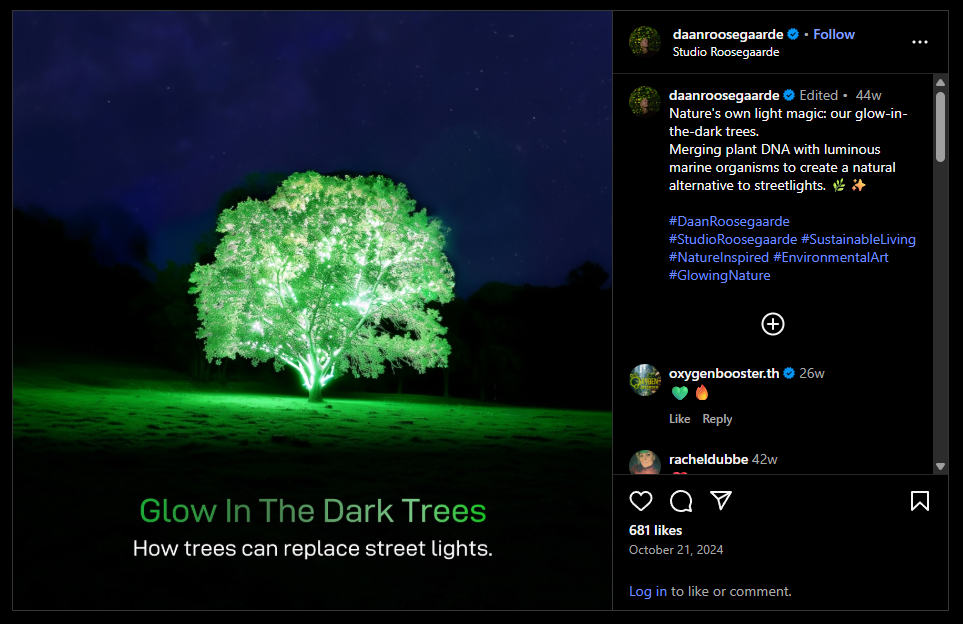
Bioluminescence means living things make light using a chemical reaction. In nature this needs fuel inside the cell and it gives a soft glow. That glow is far weaker than electric light. Early efforts to make glowing houseplants showed how hard this problem is, and the best attempts did not produce light that was useful for lighting a street. Recent science can now make plants that glow on their own by adding a full mushroom light pathway into plant cells. These plants are brighter than older versions, but even with progress they are still for decoration and research, not for outdoor public lighting.
In short, glowing trees are a beautiful vision that can inspire better design and public conversations about light, nature, and energy. For real streets, cities still rely on efficient electric lighting, smarter control of brightness, and designs that reduce light pollution.
Nature Biotechnology – Plants with genetically encoded autoluminescence – 2020
Researchers inserted a full fungal light making pathway into tobacco plants so the plants glow on their own for their whole life cycle. The study shows that plant metabolism can support bioluminescence, but the resulting light is gentle and suited to imaging and decoration, not to replacing lamps.
Nature Methods – An improved pathway for autonomous bioluminescence across eukaryotes – 2024
Scientists optimized the fungal pathway so engineered plants, fungi, and mammalian cells glow much brighter than before. The work increases brightness and makes long term imaging easier, yet it does not reach the intensity needed for public lighting.
Wired – Here come the glow in the dark houseplants – 2023
The biotech company Light Bio, co founded with academic researchers, received US approval to sell glowing petunias that use the mushroom pathway. They are safe ornamentals for the home and garden, not lighting products.
Wired – Awesome glowing roads that could be the highways of the future – 2014
A real world pilot in the Netherlands used photoluminescent road markings that absorb daylight and glow for hours at night. This shows the studio’s practical work with light in public space, separate from the idea of genetically glowing trees.
The Atlantic – Whatever happened to the Glowing Plant Kickstarter – 2017
A high profile project that promised glowing houseplants did not reach its lighting goal and shut down. The story illustrates the technical and financial limits of using bioluminescence for practical lighting.
0 Comments