
Videos of the Unitree G1 humanoid robot show clear gains in how it moves. It can run outdoors and walk with a smoother gait. The clips look exciting, but they do not prove full autonomy in messy, unknown places. For buyers and fans, the key is to separate agility from navigation and task skills.
G1 humanoid robot running: what the new clips show
Recent event videos from 2025 capture G1 running on campuses and show floors, with fewer arm flails and steadier footfalls than earlier demos. These are event demonstrations, where teams can select routes and manage risks. See examples: USC/RSS 2025 outdoor run and an ICRA 2025 demo reel that includes short sprints and boxing‑style motions :
Event demos, not deployments
Unitree told CNET that the running shots happened in unmapped spaces and were remote‑controlled. That is normal practice across humanoid labs because robust mapping, perception and safe planning in new places are still hard. Treat these as mechanics/control showcases rather than proofs of real‑world readiness. Strong demos still matter: they indicate actuator headroom, controller quality, and thermal limits under dynamic loads.
What looks improved in the gait
Stride timing appears more even, with quicker push‑off and less torso yaw. Arm swing is closer to human‑like phasing, which helps balance at speed. Foot placement looks surer on small irregularities, suggesting better state estimation and contact control. Combined, these changes point to improved whole‑body control and tuning, valuable foundations for future autonomy.
Unitree G1 price and who it is for
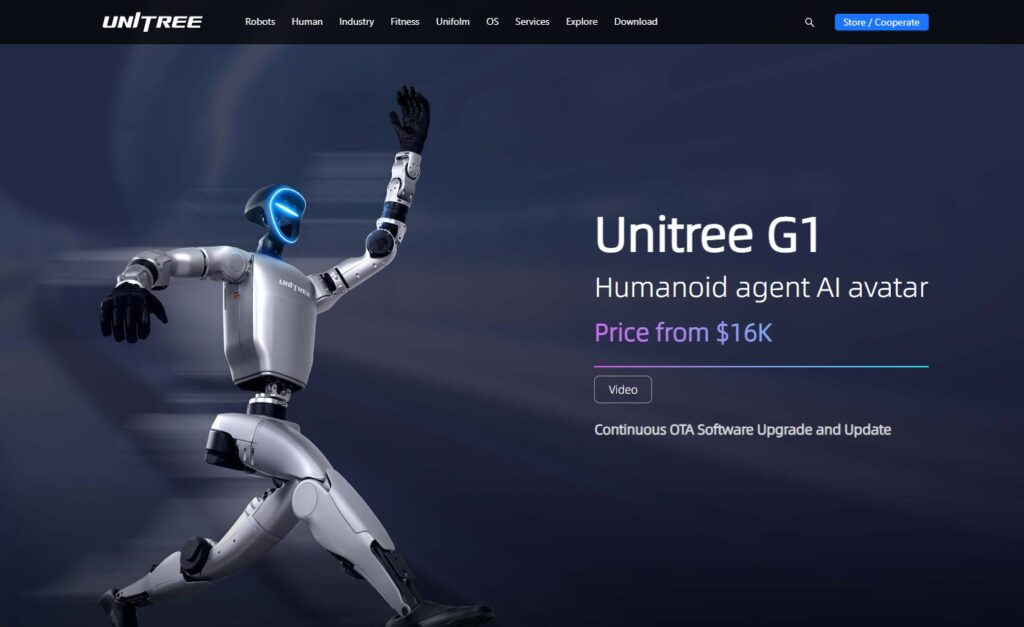
Unitree lists G1 at $16,000 on its official store, unusually low for a biped research platform (Store: https://shop.unitree.com/products/unitree-g1). The product page highlights imitation learning, reinforcement learning, dexterous hands, and wide joint ranges (Product page: https://www.unitree.com/g1). This price‑to‑capability mix targets labs, startups and advanced hobbyists who want to teach behaviors and iterate on policies rather than buy a turnkey worker.
Capabilities and claimed specs
Public spec roundups cite a top speed around 2 m/s and mass near 35 kg (example roundup: https://www.originofbots.com/robot/unitree-g1-by-unitree-robotics-details-specifications-rating). Treat third‑party tables as indicative until Unitree posts a locked spec sheet. For practical planning, focus on: continuous vs burst speed, battery swap/charge time, joint torque at key DOFs, and fall‑recovery behavior.
Where teleoperation still appears
When a clip notes that the site was not LiDAR‑mapped, assume teleoperation or tight supervision. Look for on‑screen overlays (localization maps, obstacle labels) or explicit “autonomous mode” callouts to verify autonomy. A good test is disturbance handling: minor shoves, unexpected obstacles, or route changes without a cut. If those are absent, the scene is likely curated.
H1 dancing robots and “whole‑body” control
At China’s Spring Festival Gala, Unitree’s taller H1 robots danced in sync with human performers. Reports attribute this to AI‑driven whole‑body motion control, which coordinates arms, legs and torso to track choreography while staying balanced (Business Insider coverage: https://www.businessinsider.com/china-spring-festival-robots-showing-off-humanoid-progress-2025-1). It’s a solid validation of timing, latency management and repeatability across multiple units.
What whole‑body control means in practice
In practice, whole‑body controllers solve for center‑of‑mass, foot placement and joint limits together, allowing expressive upper‑body motion without tripping the base. This improves both running (stability at speed) and dancing (style while balanced). It is not a substitute for perception, planning or manipulation; those layers decide where to go and what to do.
Multi‑robot sync vs real‑world surprises
Keeping many robots on‑beat shows tight clock sync, low actuation variance, and robust trajectory tracking. Real environments add non‑periodic surprises: people walking unpredictably, occlusions, slippery floors, and tasks requiring contact‑rich manipulation. Progress there will show up as longer uncut takes, visible perception stacks, and clear success‑rate metrics.
How G1 compares with other humanoids today
Most teams can now show agile motion. The harder step is a robot that navigates and manipulates without a script, safely, for hours, around people. Watch for: (1) clips in unmapped places still labeled autonomous; (2) task success rates over many trials; (3) fall recovery and safety documentation.
Agility Digit’s workcell strategy
Agility’s Digit emphasizes bounded workcells for logistics with dock charging and a pendant for moves between cells—a near‑term path that trades general navigation for reliability (Overview: https://www.agilityrobotics.com/solution). It’s a useful contrast with stage‑style agility demos: fewer hero moments, more repeatable throughput.
Sources & related information
CNET – Unitree’s G1 Humanoid Robots Shown Running in New Video – 2025
CNET reports that Unitree showed G1 running and H1 dancing, and adds that the running demos were teleoperated in unmapped spaces; these claims come directly from Unitree’s notes to the outlet (CNET report by Jesse Orrall).
Unitree – Unitree G1 – Product page – 2025
The official G1 page outlines the platform’s goals (embodied AI with imitation learning), highlights dexterous hands, and lists high-level specs suitable for research users (Unitree G1 product page).
Unitree – Unitree G1 – Price and purchase page – 2025
The official store listing shows G1 at $16,000, positioning it as a comparatively low‑cost biped platform for labs and developers (Unitree shop listing).
YouTube – G1 outdoor run at USC/RSS 2025 – 2025
Event footage shows G1 jogging outdoors on campus, illustrating smoother gait and steadier footfalls than earlier clips in a live setting (USC/RSS 2025 run).
YouTube – Unitree G1 demo reel (ICRA 2025) – 2025
A show‑floor reel captures short sprints and boxing‑style motions, typical of agility‑focused demonstrations under supervision (ICRA 2025 demo reel).
Agility Robotics – Digit – Solution overview – 2025
Agility describes a workcell‑first deployment model with dock charging and supervised moves, a contrast with stage‑style agility demos and useful context for readers (Agility solution overview).
0 Comments