
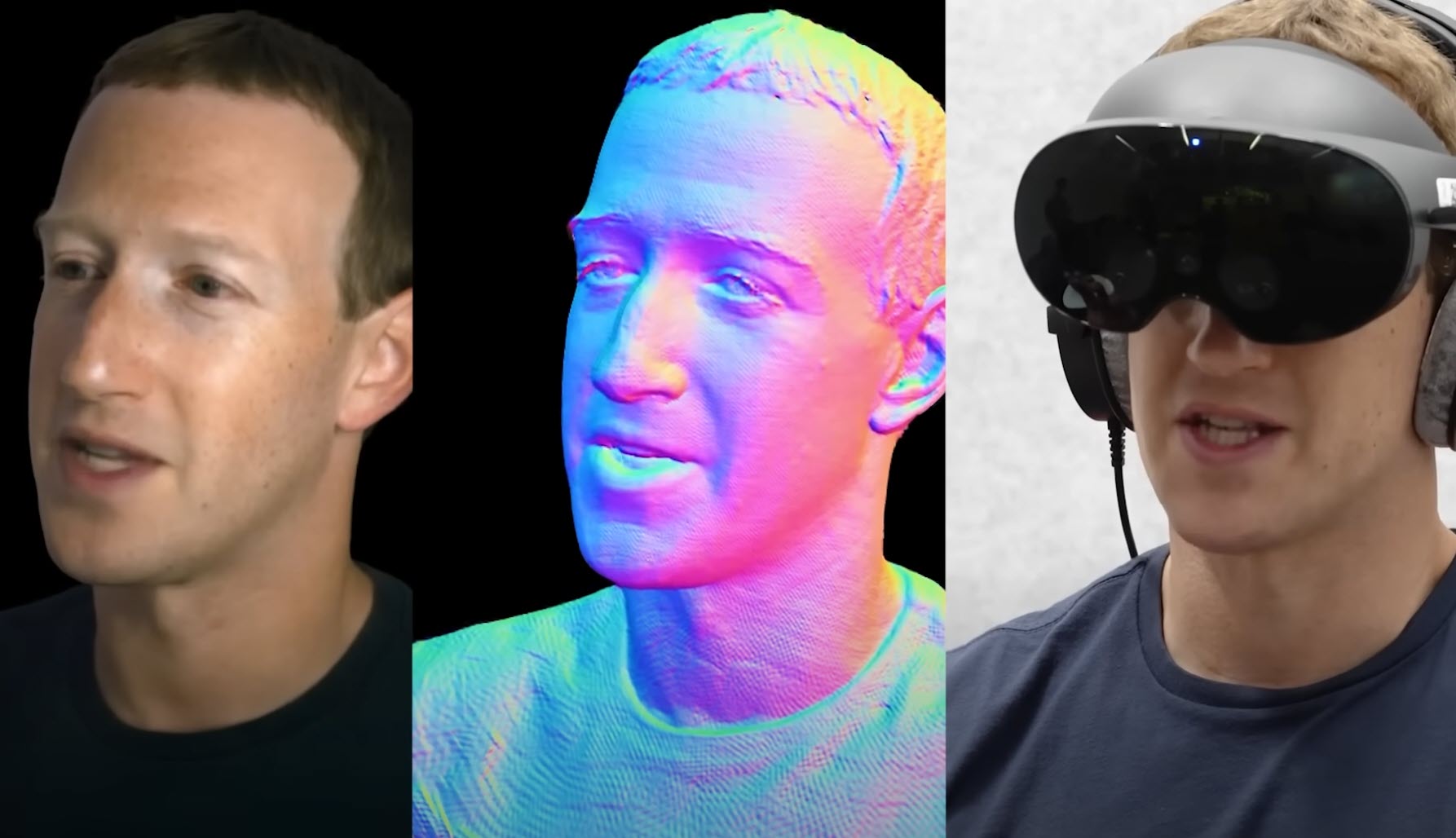
The metaverse is moving toward meetings where you appear as a life-like 3D version of yourself, with your face and expressions reproduced in real time. Public demos from major companies show that this level of realism is not science fiction anymore.
How today’s most realistic avatars work
The most convincing systems learn your face, skin, and expressions during a short capture step, also called a scan. Meta’s research prototypes, known as codec avatars, have shown interviews where two people speak as near-photographic 3D versions of themselves with precise eye and mouth motion. This quality was first built with dedicated capture rigs, then improved so parts of the pipeline can work from simpler scans, but a capture step is still required.
What “scan” means in practice
A scan does not always require a studio. Apple Vision Pro creates a realistic upper-body “Persona” by asking you to hold the headset in front of your face so its cameras can record your features. This is a guided capture inside the device. The result is a live avatar that mirrors your face and hands during calls.
Tools for creators and studios
For film, games, and brand events, studios still use volumetric capture, which records a person from many angles to build a full 3D performance. This method produces detailed 3D humans for VR and AR experiences. New creator tools also help. Epic’s MetaHuman Animator can drive a high-detail digital human from an iPhone performance capture in minutes, lowering the barrier to realistic animation.
Why realism is improving fast
Recent research lets software rebuild 3D scenes from ordinary photos and videos with far greater speed and detail. Neural radiance fields, then 3D Gaussian splatting, made it possible to capture objects and spaces with hair-level detail and render them in real time, which is key for believable avatars and environments on consumer hardware. These techniques are being adopted across the industry.
Limits to know today
The highest-end demos still need strong computing power and careful lighting. Many consumer systems show only the head and hands, not full bodies, and some avatars still look slightly off under certain lighting. Privacy and security around face scans and expression data remain important topics. Even with these limits, the direction is clear, realism is rising and capture steps are getting simpler.
Verification of the claim
Is the technology able to recreate people in 3D with very realistic results? Yes, public demos from Meta and Apple show life-like 3D avatars with natural expressions, and independent reports confirm the effect is striking. Do you need to be scanned first? For photorealistic avatars, yes, there is a capture step, from a quick on-device scan to a studio-level capture, depending on the system. Stylized avatars may skip this, but they are less realistic.
NeRF, Representing Scenes as Neural Radiance Fields for View Synthesis – 2020
Introduces a learning method that rebuilds a 3D scene from a set of images, then renders new views with high realism. This became a core idea for modern 3D capture used in VR and AR.
3D Gaussian Splatting for Real-Time Radiance Field Rendering – 2023
Replaces classic 3D meshes with millions of tiny “splats,” enabling photorealistic scenes that render in real time, a key step for believable, responsive 3D avatars and spaces.
The tech to build the holodeck – 2025
Reports rapid adoption of Gaussian splatting by companies such as Niantic, Google, Snap, and Meta, noting its impact on realistic, real-time 3D capture for AR and VR.
Apple Vision Pro, how Personas are created – 2024
Official guide that shows the on-device face scan used to capture your Persona, Apple’s realistic avatar for calls and meetings.
0 Comments