
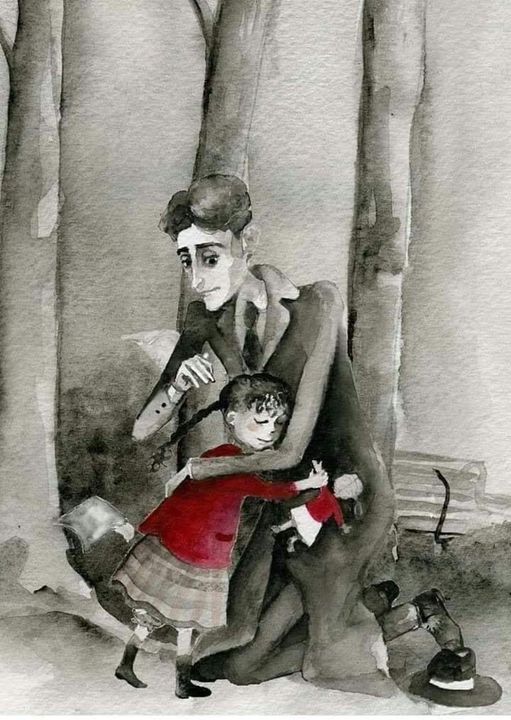
At 40, Franz Kafka (1883-1924), who never married and had no children, was walking through a park one day in Berlin when he met a girl who was crying because she had lost her favourite doll.
She and Kafka searched for the doll unsuccessfully. Kafka told her to meet him there the next day and they would come back to look for her.
The next day, when they had not yet found the doll, Kafka gave the girl a letter “written” by the doll saying “please don’t cry. I took a trip to see the world. I will write to you about my adventures.”
Thus began a story which continued until the end of Kafka’s life.
During their meetings, Kafka read the letters of the doll carefully written with adventures and conversations that the girl found adorable.
Finally, Kafka brought back the doll (he bought one) that had returned to Berlin.
“It doesn’t look like my doll at all,” said the girl. Kafka handed her another letter in which the doll wrote: “my travels have changed me.”
The little girl hugged the new doll and brought the doll with her to her happy home.
A year later Kafka died…
Many years later, the now-adult, girl found a letter inside the doll. In the tiny letter signed by Kafka it was written:
“Everything you love will probably be lost, but in the end, love will return in another way.”
Embrace change. It’s inevitable for growth. Together we can shift pain into wonder and love, but it is up to us to consciously and intentionally create that connection.
This story about Franz Kafka and the girl in the park is widely circulated and beloved, but it is more likely to be a legend or parable than a documented historical event. There is no concrete evidence in Kafka’s biographies or writings that this event actually occurred. The story first appeared in accounts decades after Kafka’s death, particularly through Dora Diamant, his last companion, who mentioned Kafka’s fondness for telling stories to children.
The tale captures the essence of Kafka’s creative and empathetic spirit and is often used to illustrate themes of loss, transformation, and the power of storytelling. However, the details, including the final letter found inside the doll, are almost certainly fictional. It’s best appreciated as a poignant and inspirational narrative rather than a literal recounting of Kafka’s life.
0 Comments